
Dubai’s climate is brutal on the wrong materials. Summer surface temperatures on dark stone or metal fittings can exceed 60°C, UV exposure is intense and constant, and the region’s water is naturally hard, which accelerates scaling on the wrong tile or grout. A material that performs well in a milder climate can fail here within a few seasons — cracking, fading, or becoming too hot to walk on barefoot.
This guide breaks down what actually works for swimming pool construction in Dubai, across the three material decisions every pool owner makes: the shell, the finish, and the deck.
Table of Contents
Shell Materials: Concrete, Fiberglass, or Vinyl
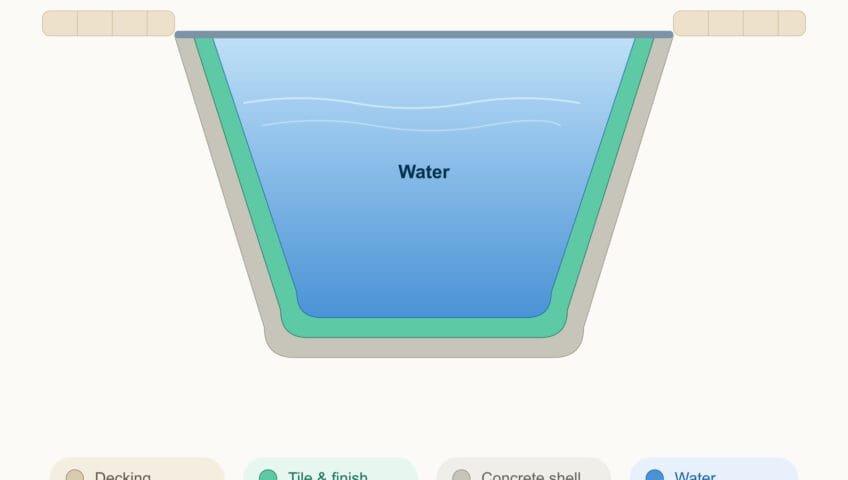
Concrete (gunite/shotcrete) is the standard choice for custom villa pools in Dubai, and for good reason: it can be shaped into any design (infinity edges, freeform lagoon shapes, integrated spas), it’s extremely durable against ground movement and temperature swings, and it holds up well over decades with proper maintenance. The trade-off is a longer build time — the shell needs curing time before finishing work begins — and a higher cost than prefabricated options.
Fiberglass shells arrive pre-formed and are installed faster than concrete, with a smoother, more algae-resistant surface. The limitation is shape: you’re choosing from a manufacturer’s mold rather than a fully custom design, which is why fiberglass is less common for the large, architecturally distinct villa pools typical in Dubai’s premium communities. It’s a reasonable option for smaller, straightforward pool shapes where speed matters more than customization.
Vinyl-lined pools are rare in the UAE market and generally not recommended here — the liner material tends to degrade faster under intense, near-constant UV exposure than in more temperate climates, shortening its practical lifespan.
Our recommendation: for most Dubai villa projects, concrete/gunite remains the better long-term choice — it’s what we use for the majority of our custom pool builds, balancing design flexibility with proven durability in this climate.
Finish Materials: Tiles, Plaster, and Aggregate
The finish is what you actually touch and see every day, and it takes the most direct sun and water-chemistry exposure.
Porcelain tile is UV-resistant, doesn’t fade, and resists the scaling that comes from Dubai’s hard water better than most alternatives — it’s our default recommendation for pool interiors here.
Glass mosaic tile delivers a premium look (especially in blues and teals that make water appear more vivid) and holds color exceptionally well under UV, but installation is more labor-intensive and costs more than porcelain, especially on curved surfaces like spillover edges.
Natural stone (Sukabumi stone, travertine composite finishes) has become a popular high-end trend in Dubai villa pools for its soft, textured look underfoot. It performs well in this climate but needs proper sealing to resist staining from the region’s mineral-heavy water.
Plaster/marcite is the most budget-friendly finish but has the shortest lifespan in intense sun and hard water — expect to resurface sooner than with tile, typically within 7-10 years versus 15+ for quality porcelain or glass tile.
Aggregate finishes (pebble or quartz-based) sit between plaster and tile on both cost and durability, offering a textured, slip-resistant surface that many families with children prefer.
Decking Materials
The deck surrounding your pool matters as much as the pool itself in Dubai — this is the surface bare feet touch on a 45°C afternoon.
Travertine is the most popular decking choice in Dubai for good reason: it stays noticeably cooler underfoot than most alternatives, has a naturally slip-resistant texture when honed or brushed, and weathers well outdoors.
Composite decking (wood-look synthetic boards) offers a warmer aesthetic than stone with less maintenance than real timber, though quality varies significantly between manufacturers — cheaper composites can warp or fade faster in direct sun.
Natural timber delivers the most premium look but requires the most upkeep in this climate — regular oiling and sealing to prevent sun damage and splitting. Best suited for covered or partially shaded deck areas rather than full-sun exposure.
Porcelain paving (large-format outdoor tile) is increasingly used for a clean, modern deck aesthetic, particularly for geometric and minimalist pool designs — see our pool design guide for examples of the styles this pairs with.
Quick Comparison Table
| Material | Best for | Watch out for |
|---|---|---|
| Concrete/gunite shell | Custom shapes, long-term durability | Longer build time, higher cost |
| Fiberglass shell | Faster installs, standard shapes | Limited design flexibility |
| Porcelain tile finish | Most Dubai pools, UV/hard water resistance | Higher cost than plaster |
| Glass mosaic finish | Premium aesthetic, color depth | Labor-intensive installation |
| Natural stone finish | High-end textured look | Needs sealing against mineral staining |
| Plaster finish | Budget builds | Shortest lifespan in this climate |
| Travertine decking | Most Dubai villa decks | Needs periodic sealing |
| Composite decking | Low maintenance, wood look | Quality varies widely by brand |
| Natural timber decking | Premium look, shaded areas | High maintenance in full sun |
What to Avoid in Dubai’s Climate
- Dark-colored decking materials in direct sun exposure — surface temperatures can become genuinely painful to walk on barefoot by early afternoon
- Vinyl liner pools — UV degradation shortens lifespan significantly compared to tiled or plastered shells
- Untreated or unsealed natural stone — Dubai’s hard water will cause mineral staining within a season or two without proper sealing
- Budget plaster finishes on high-use family pools — the shorter resurfacing cycle often costs more over a decade than choosing tile from the start
FAQ
What’s the best pool shell material for a Dubai villa?
Concrete/gunite is generally the best choice for custom villa pools, offering full design flexibility and strong long-term durability in this climate.
Is fiberglass a good option for Dubai pools?
It can be, particularly for smaller or standard-shaped pools where faster installation matters more than full customization.
What tile is best for pools in hard water areas like Dubai?
Porcelain tile is generally the most resistant to the scaling caused by hard water, alongside strong UV and fade resistance.
What’s the coolest decking material for bare feet in Dubai summers?
Travertine is the most common recommendation — it stays noticeably cooler underfoot than composite or dark stone alternatives.
How often does a plaster pool finish need replacing in Dubai?
Typically every 7-10 years, versus 15+ years for quality porcelain or glass tile, due to intense UV exposure and hard water.
GET IN TOUCH
Not sure which materials fit your project and budget?
Poolsco guides every material decision based on what actually performs in Dubai’s climate.